Before you continue

Confirm your stucco type

Please confirm that the stucco you want repaired or worked on is EIFS, also known as synthetic stucco, which contains a Styrofoam insulation layer.

Not sure which stucco you have? Call us at (941) 288-0652 before continuing.

FESG Florida EIFS Stucco Group
FESG Stucco & EIFS Guide

Hurricane Stucco & EIFS Damage: How to Spot It on Sarasota Homes

Storm checklist for stucco and EIFS walls: cracks, impact damage and water signs to look for, how each is repaired, and how to document damage.

EIFS & Stucco Specialists
Installation, repairs, restoration and protective exterior finishes.

Residential & Commercial
Experienced crews for houses, condos, multifamily and retail exteriors.
Southwest Florida Coverage
Sarasota, Bradenton, Venice, Fort Myers, Naples and surrounding communities.

Practical stucco & EIFS guidance

FESG Florida EIFS Stucco Group ·

Three-story multifamily building with gray and white EIFS panels and dark faux wood accents
Multifamily EIFS exterior by FESG. Reveals, balconies, and transitions are where storm water tends to find its way in.

After a hurricane or a strong tropical storm, most people check the roof first. The walls deserve the same look. Wind-driven rain pushes water sideways into every crack, joint, and window perimeter, and flying debris punches holes that are easy to miss from the driveway. Small damage found early is a patch. Damage found a season later can mean wet sheathing, rusted lath, and a much bigger repair.

First: know which wall system you have

Storm damage looks different on traditional cement stucco and on EIFS, the insulated systems made by Sto and Dryvit, and they are repaired differently. Most Sarasota block homes have cement stucco. Condos, apartments, commercial buildings, and frame-built second stories are often EIFS. OurEIFS vs stucco guideexplains how to tell them apart.
Storm damage checklist

On cement stucco

  • New or wider cracks, especially diagonal cracks from window and door corners and stair-step cracks following block joints.
  • Hollow-sounding areas when you tap the wall, which points to stucco that has let go of the block.
  • Rust stains or bleeding at corners and edges, where water has reached the metal corner bead or lath.
  • Chips and spalls where debris hit the wall.

On EIFS (Sto, Dryvit)

  • Dents, punctures, and gouges that expose foam. Even a small hole lets water reach the insulation and the barrier behind it.
  • Soft spots that give when pressed, a sign of moisture behind the finish.
  • Open or split sealant joints at windows, doors, light fixtures, and penetrations.
  • Damage at the bottom edge of the wall and at terminations above roofs, where splash-back and runoff collect.

On both

  • Water staining or blistering on the finish below windows and at roof-to-wall lines.
  • Stains, musty smells, or soft drywall inside on exterior walls.
  • Peeling paint or efflorescence (white powder) that wasn't there before the storm.
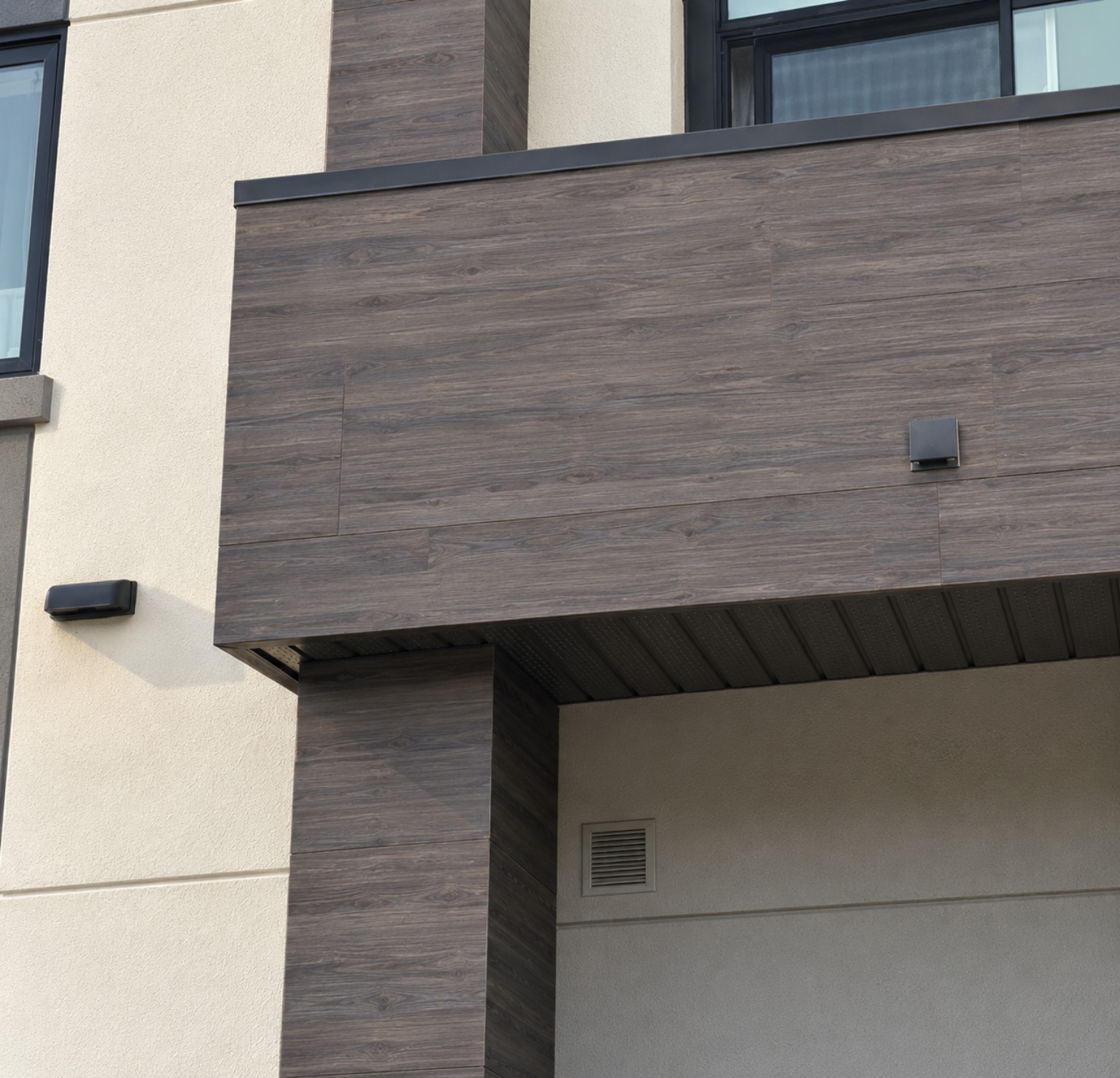
EIFS wall with a dark faux wood balcony and column, a wall-mounted light, and a vent penetration
Check every penetration after a storm: light fixtures, vents, and the joint where the balcony meets the wall. These sealant joints are the first line of defense.

How each system should be repaired

Cement stucco

Loose stucco is cut back to sound material. Damaged lath or corner bead is replaced. New stucco goes on in coats with time to cure, and the finish texture is matched to the surrounding wall before painting. Cracks are opened and filled with a compatible material instead of being smeared with caulk, which tends to show and to fail again.

EIFS

Damaged EIFS is cut out to a clean square edge. The barrier behind it is checked and repaired, and new foam is fit into the opening. New mesh is lapped onto the existing mesh, and the base coat and finish are applied and textured to blend. The repair uses the original manufacturer's materials: Sto components on a Sto wall such as StoTherm ci, and Dryvit components on a Dryvit wall. Mixing systems or patching foam with cement is how "repaired" EIFS ends up cracking around the patch.

Do not pressure-wash a storm-damaged wall before it is inspected. Water forced into an open crack or puncture goes straight behind the finish.

Document the damage

  1. Photograph each side of the building from a distance, then take close-ups of every crack, hole, and stain. Put a coin or tape measure in the shot for scale.
  2. Note the date and which storm caused the damage.
  3. Keep any debris that hit the wall, if it is safe to do so.
  4. If the wall is open to water, ask for a temporary seal now and a permanent repair afterward, and keep the receipts.

When to call

Call right away if you can see foam, block, or lath, if anything is soft or loose, or if there are signs of water inside. For hairline cracks with no other symptoms, a scheduled inspection is enough. Either way, sending us photos is the fastest way to find out what you are looking at.

More stucco guides

Related services